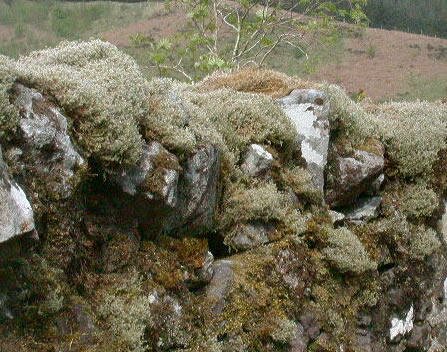
|
What is a dry stone wall?
Dry stone walls are the dominant field boundaries in some areas. Helpful
descriptions are provided by the British Trust for Conservation Volunteers
(1994) and Agate et al (1999). The walls are free-standing and rest on a
foundation of large stones set in a trench. Layers of stone are then built
upwards, without mortar, with the largest stones at the bottom and the smallest
at the top. All stones are laid level or dipping outwards, and with stones in
successive rows overlapping each other rather than straight on top of each
other. Two horizontal structures like this are built with a gap between, leaning
towards each other, and the centre is filled with stones of varying sizes to
give a solid structure. At intervals, long stones (throughs) are laid across the
wall to hold the two sides together. A line of coping stones is commonly laid on
top. The illustration below is from a BTCV (1994) pamphlet.
(© BTCV)
The detailed design varies from area to area. Sometimes, throughs are replaced
by bonders (or ¾ throughs), which go about ¾ of the way through the wall, and
should be adjacent and overlapping to provide the strongest structure. Coping
stones may be omitted, or laid flat across the top. Walls which look similar on
their visible side but supporting earth on the other are not included in the
definition.
What do we know of the flora of dry stone walls?
The flora of dry stone walls has been little investigated, almost all work on
wall flora being based on walls generally (Darlington 1981; Segal 1969; South
Court Environmental Ltd 1994). The only directly relevant sources located are
Payne (1989), Williams (1988) and Watson (1968). A number of people have become
interested in further investigation and this website is a means of collating the
results as they appear.
What do we need to know?
A number of key questions can be identified relating to the flora of dry stone
walls and these are listed below. Investigations for them are already in
progress, and it is hoped to include results on this site soon.
1. What kinds of plants, lichens and fungi grow on dry stone walls?
2. Which of these organisms grow on limestone dry stone walls and which on walls
constructed of acid rocks?
3. Is the flora of dry stone walls significantly and consistently different from
that of mortared walls?
4. Can the flora of dry stone walls be distinguished from the flora of the
surrounding environment?
5. How does the flora of dry stone walls fit into the National Vegetation
Classification?
6. How can the flora of dry stone walls be conserved and enhanced?
Further information from
John Presland, 175c Ashley Lane, Winsley, Bradford-on-Avon, Wilts BA15 2HR. Tel
01225 865125
References
Agate E, Brooks A and Adcock S (1999). Dry Stone Walling. BTCV, Doncaster.
British Trust for Conservation Volunteers (1994) How to dry stone wall. BTCV,
Doncaster.
Darlington A (1981) Ecology of Walls. Heinemann Educational, London.
Payne R M (1989) The flora of walls in the Chew Valley. Somerset Archaeology and
Natural History 133: 231-242
Segal S (1969) Ecological Notes on Wall Vegetation. Dr. W. Junk N. V., The
Hague:
South Court Environmental Limited (1994) What’s on a Wall? The Ecology of Walls,
edn 3.South Court Environmental Limited, Northampton.
Watson E V (1968) British Mosses and Liverworts. Cambridge University Press,
Cambridge.
Williams L. (1988) Observations on the flora of wall habitats on Yell, Shetland,
in J. A. Fowler ed. Ecological Studies in the Maritime Approaches to the
Shetland oil Terminal: Report of the Leicester Polytechnic to Shetland, August
1986 and July 1987. Leicester Polytechnic, Leicester.
|